Meet us at the
Smart Buildings Show 2026
Are you Switched On?
Smart Building Show 2026
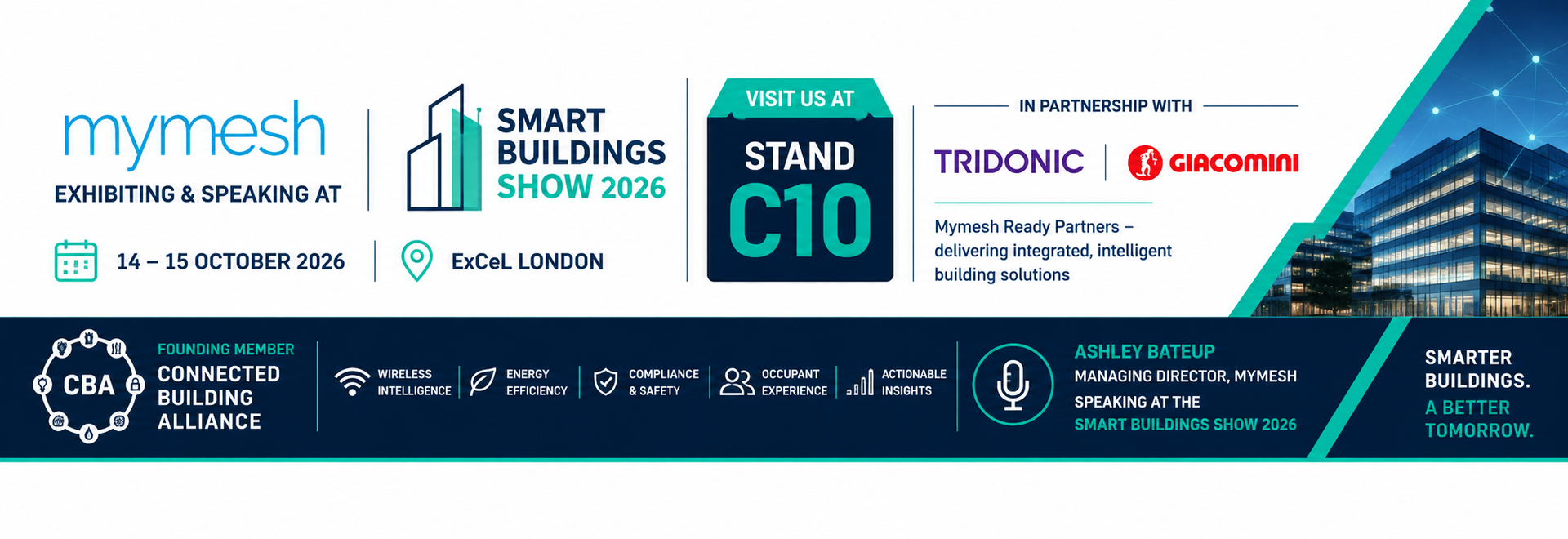
Mymesh will be exhibiting Smart Buildings Show 2026, 14–1n, bringing together technology, expertise and industry partners to demonstrate a more joined up approach to intelligent buildings.
Venue: ExCeL | London
Date/Time: 14 - 15 October 2026
Stand: C10
Discover what Mymesh can do for your built environment
Smart Building Show 2026
Data & Intelligence: Driving Smarter, Safer Buildings
Visit us on Stand C10, where Mymesh will be joined by Tridonic and Giacomini, two of our key Mymesh Ready partners.
Together, we will demonstrate how lighting, climate, occupancy and building intelligence can converge on a common digital infrastructure, creating buildings that are simpler to operate, more energy efficient and capable of delivering better outcomes throughout their lifecycle.
See connected building technology working together
Smart buildings should not be created by adding more isolated systems.
Mymesh provides a secure wireless intelligence layer that connects building assets, captures real time information and enables systems to respond dynamically to how a building is actually being used.
At Stand C10 we will be demonstrating how this approach brings together:
- Intelligent lighting with Tridonic and Mymesh Ready technology
- Occupancy led climate control with Giacomini
- Energy monitoring and optimisation
- Emergency lighting compliance and automated reporting
- Occupancy and space intelligence
- Building and asset data
- Actionable insights for facilities and estate teams
- Augmented Reality - how new ways of accessing data and actionable insights
The result is an infrastructure led approach to smart buildings where lighting becomes the foundation for a much wider connected building strategy.
Mymesh + Tridonic + Giacomini
Three technologies. One connected building approach.
Our partnership with Tridonic embeds Mymesh intelligence directly within lighting infrastructure, enabling manufacturers, contractors and building owners to deploy intelligent lighting without introducing unnecessary gateways or proprietary control architecture.
Our work with Giacomini extends that same intelligence into climate control, using occupancy and environmental data to influence heating and cooling demand at room and zone level.
Together, this demonstrates an important evolution in building controls:
One understanding of occupancy. Multiple building systems responding intelligently.
Rather than lighting and HVAC operating independently, the building can begin to behave as a connected system.
Speaking at Smart Buildings Show
Lighting and Climate Convergence: A New Paradigm for Smart Buildings
Ashley Bateup
Managing Director, Mymesh
Thursday 15 October 2026 | 13:00
Controls & Networks Theatre
Lighting and climate control have traditionally existed as separate building systems, each with their own sensors, controls, networks and data.
But what happens when they share a common understanding of occupancy?
In this session, Ashley Bateup will explore how the convergence of intelligent lighting, occupancy sensing and demand led climate control can create a new generation of responsive buildings.
The session will examine how connected infrastructure can reduce energy consumption, simplify building controls and provide richer operational insight, while creating a scalable digital foundation for future building services.
Using practical experience from commercial and public sector estates, Ashley will explore why the next generation of smart buildings may not begin with the BMS.
From Smart Lighting to Intelligent Buildings
Lighting is one of the most extensive pieces of infrastructure within almost every occupied building.
The transition to LED therefore represents much more than an opportunity to reduce lighting energy.
By embedding intelligence into the lighting infrastructure, building owners can create a distributed network of sensors and connected assets capable of supporting occupancy intelligence, energy management, emergency lighting compliance, environmental monitoring, climate control and wider estate digitisation.
This is the approach behind Mymesh.
Start with lighting. Build the digital infrastructure. Add intelligence as the building evolves.
Asset Tracking
Connected assets are often valuable, mobile and difficult to locate when they are needed. This can lead to wasted time, unnecessary replacement costs and inefficient use of resources.
Mymesh asset tracking provides real time visibility of connected equipment across buildings and estates, helping teams quickly locate assets, understand utilisation and improve operational efficiency.
By combining asset location with occupancy and building data, organisations can make better decisions about how assets are deployed, maintained and managed throughout their lifecycle.


L8 Compliance
Water hygiene compliance can be resource intensive, particularly across large or complex estates where outlets must be routinely monitored, flushed and recorded.
Mymesh water monitoring automates much of this process by using wireless sensing to track outlet activity and temperature, with compliance information captured directly within a central dashboard.
This allows teams to focus manual flushing only on outlets that genuinely require attention, reducing unnecessary water consumption, administrative workload and operational cost, while providing a clearer and more auditable compliance record.
Complimented by certified Giacomini valves, Mymesh can control the flow of water, eliminating dead legs or automating flushing.
Wayfinding
Large and complex buildings can be difficult to navigate, particularly for visitors, contractors and people unfamiliar with the estate. Poor wayfinding can lead to delays, missed appointments, frustration and additional demands on staff.
Mymesh indoor positioning and wayfinding uses the existing wireless network to create a dense, building wide location infrastructure that can support accurate navigation through a mobile application or digital service.
Because each Mymesh device can act as a secure location beacon, organisations can provide precise indoor positioning without adding a separate dedicated network. This creates a scalable foundation for wayfinding, location based services and occupant experience, while maintaining secure, privacy conscious operation.


Emergency Lighting
Emergency Lighting is required in buildings to avoid darkness when the general lighting fails. Emergency lighting should operate automatically and result in sufficient lighting levels to evacuate safely. The British Standard BS 5266-1 gives clear guidelines on how to design and install emergency lighting. Testing forms an essential part of the statutory compliance requirements.
Mymesh can monitor, test and report on the emergency lighting. Next to giving a foundation for compliance, it also delivers significant savings on the maintenance. Both by eliminating the manual monthly and yearly testing, but also by providing the information for 'first fix engineering'. The system tells you immediately when it fails, why it fails and where it is located. Moreover, it confirms when a fault is cleared.
For many clients, the Emergency lighting alone already provides the business case for the investment.
Energy Savings
Energy optimisation goes far beyond simply replacing inefficient equipment. The greatest gains come from understanding where, when and how energy is being used, then controlling loads dynamically in response.
Mymesh IoT energy measurement and control provides real time visibility of connected electrical loads and enables them to be managed intelligently using occupancy, schedules, environmental conditions and operational demand.
By combining granular energy data with automated control, organisations can reduce unnecessary consumption, optimise lighting and other building loads, identify abnormal usage and improve overall asset performance.
For lighting, this can include high end trimming, presence control and daylight harvesting, reducing energy consumption while also lowering operating hours and extending the life of the installation.
The result is a more efficient building where energy is measured, understood and actively controlled, rather than simply consumed.

Improving peoples lives
by making buildings smart
The average person will spend 41 years of their life working. The productivity of that time is strongly related to the environment where you work.
So, wouldn't it be better for the environment to adapt around you, rather than you to it?
With Mymesh, this dream becomes a possibility.


Mymesh projects